If you click on a link and make a purchase we may receive a small commission. Read our editorial policy.
The rise and fall of Millie the Model, Marvel Comics' most prolific female character of all time
Inside the Marvel Comics ingenue that went from a company staple to a company recluse


Marvel Comics' most prolific female character is someone who beats the others by a mile, but is also someone many Marvel fans has never even heard of.
Millie.
Marvel Comics' Millie the Model was a groundbreaking series starring Millie Collins, a working girl trying to make it in the fashion industry. During it’s heyday, the comic was a top-seller, featuring some of the earliest work from various industry legends, and has the distinction of being the first Marvel Comic to feature a black woman as a regular supporting character. Despite all this, Millie has almost been forgotten.
How did one of Marvel’s biggest superstars fall from grace, and is there hope for a comeback? Let’s examine the colorful career of Millie the Model.
Marvel's Millie the Model: Sequins and superstardom
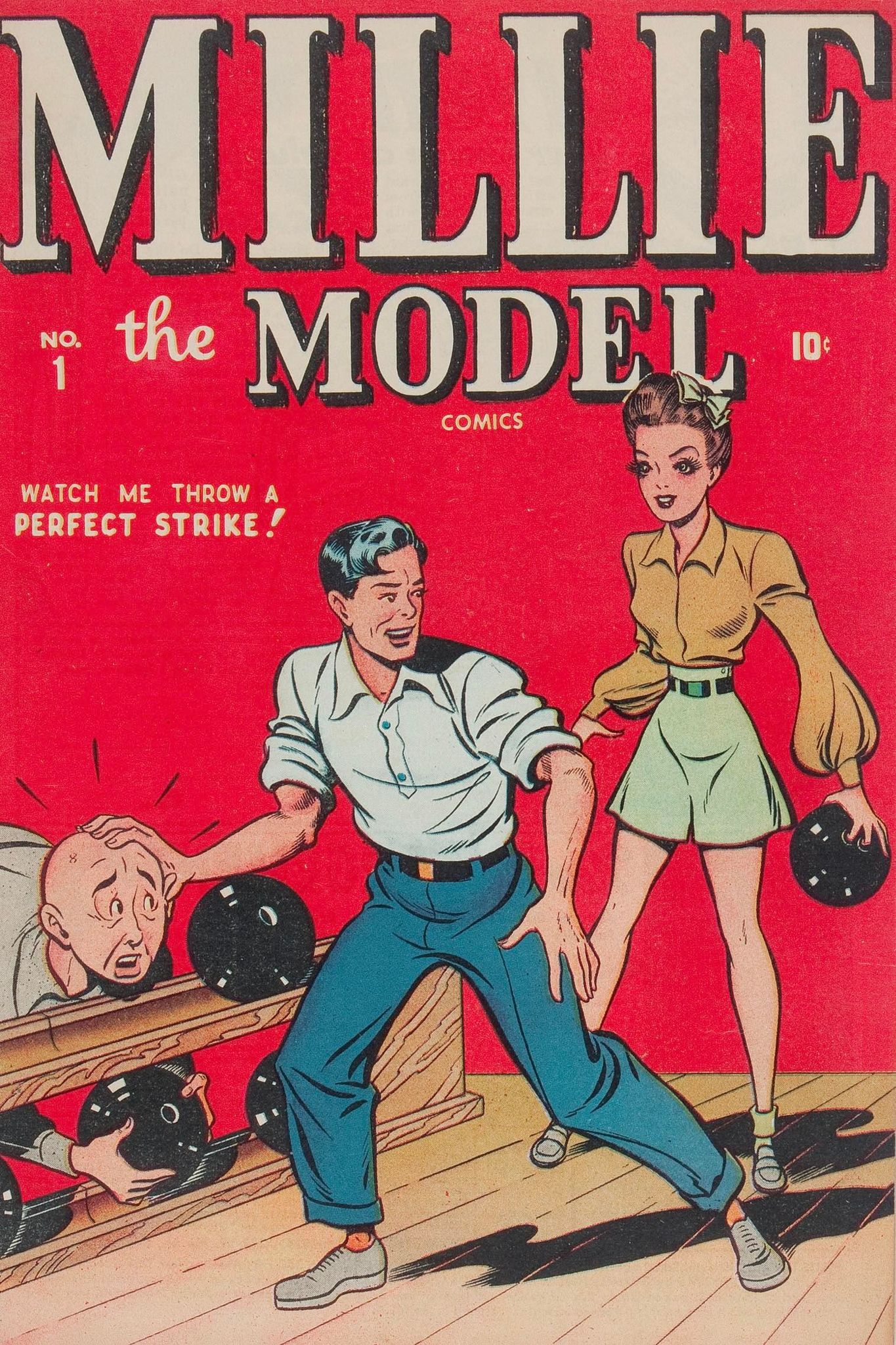
Millie Collins made her grand debut in Millie the Model #1 (1945) published by Timely Comics, the name Marvel went by at the time. The circumstances behind Millie’s creation have been lost to time, and as a result there are some contradictory accounts of her origins. For example, some websites and reference books credit Joe Devlin, but contemporary comic scholars have debunked that. In the coffee table book Marvel: Five Fabulous Decades of the World’s Greatest Comics author Les Daniels credits Stan Lee with creating Millie, while most contemporary historians believe it was cartoonist Ruth Atkinson, who wrote and drew the first issue.
The series followed Millie Collins, a young woman from the Midwest who moves to New York City with big dreams of becoming a model. She joins the Hanover Modeling Agency, operated by Larry Hanover (later renamed Howard). The agency’s in-house photographer Flicker Holbrook (later renamed Clicker) soon became Millie’s boyfriend, although some stories played with the idea of Mr. Hanover having a secret crush. The series followed Millie’s misadventures as each modeling assignment resulted in a string of comedic follies.
Millie the Model #4 (1947) introduced Chili Seven (later renamed Chili Storm), a character who would change the direction of the series. Chili was a red-headed model who served as Millie’s rival. The two of them enjoyed a friendly rivalry, as the mean spirited Chili would constantly try to one-up Millie. Most stories centered around their playful rivalry, which usually resulted in karma hitting Chili, and Millie coming out on top. Interestingly, Women of Marvel: Celebrating Seven Decades Handbook proposes the idea that Chili Storm might be a distant relative of Susan and Johnny Storm of the Fantastic Four, but as of this writing nothing has been confirmed.
Ken Bald, one of the earliest writers and artists on the title, used his wife as a model for Millie. In 1947 Stan Lee self-published a pamphlet called Secrets Behind The Comics, which claimed that Timely Comics flew Ken Bald and his wife out to Paris in order to make Millie the Model #9 more authentic. Longtime Marvel editor Tom Brevoort believes this claim is exaggerated since it’s unlikely that Timely Comics would’ve financed a European trip for the sake of a single comic. Years before he became known for Justice League of America and Wonder Woman, Mike Sekowsky penciled some of Millie’s earliest stories.
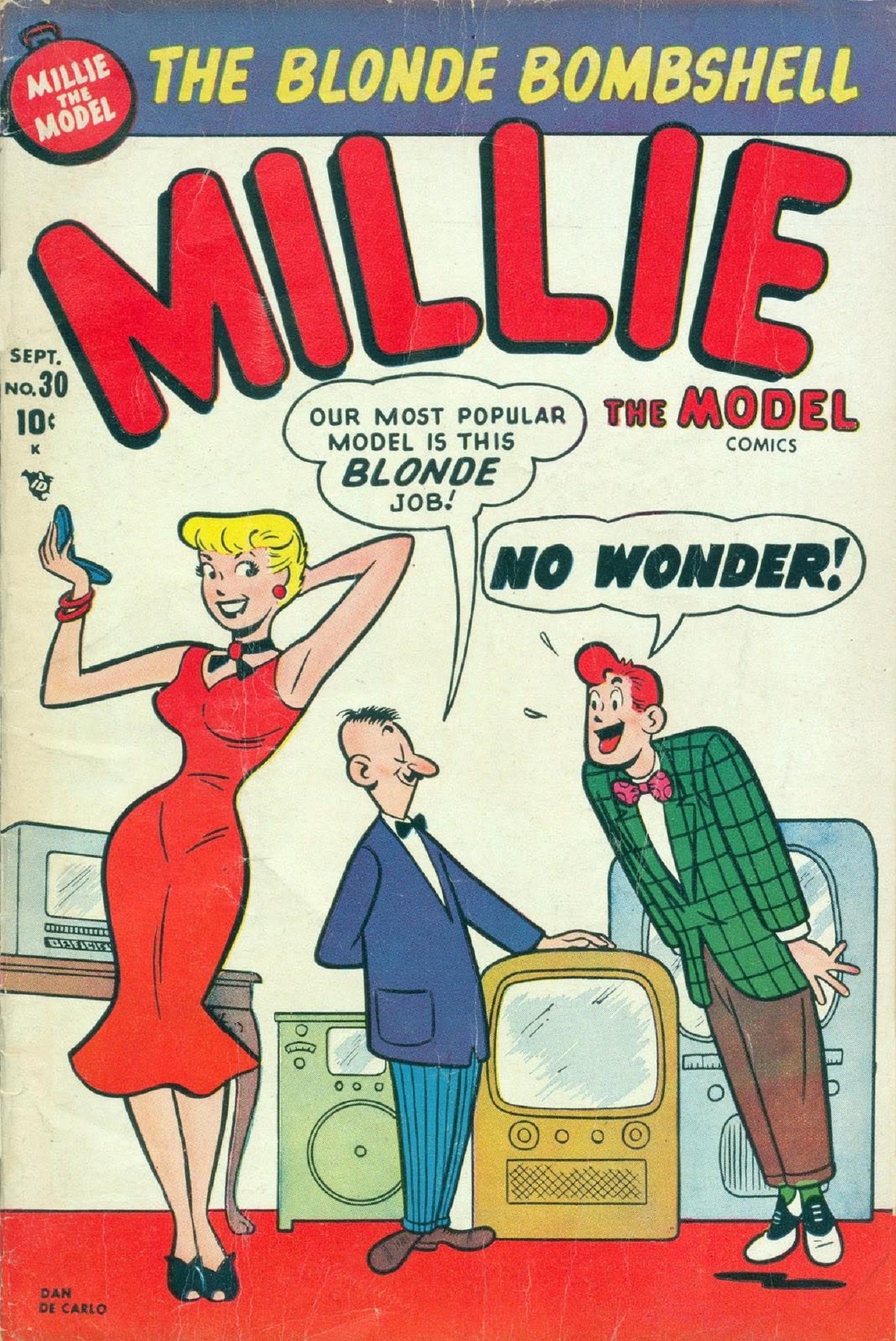
Millie the Model #17 (1948) was the first issue of the Stan Lee and Don DeCarlo run. This partnership would not only revolutionize the title, but it also had major ramifications for the comic book industry as a whole. Dan DeCarlo injected new energy into the book with his stylized penciling, which perfectly complimented the slapstick in Lee’s scripts. During a 2001 interview, DeCarlo credited Millie with saving his career.
“That was a big break for me. It wasn’t doing too well, and somehow when I got on it became quite successful,” DeCarlo recalled.
DeCarlo eventually went to Archie Comics, where his work became the house style for Archie and his family of characters. While looking at his issues of Millie the Model, you can see DeCarlo slowly develop the style that would later become Archie’s signature look. It’s hard not to see Archie Andrews and Betty Cooper in some of these illustrations of Clicker and Millie. In some ways, Millie the Model can be partially credited with influencing the direction of Archie Comics. DeCarlo’s style also became the standard look for Millie, with artist Stan Goldberg emulating it during his run.
The Stan Lee and Don DeCarlo run lasted almost 11 years, ending in Millie the Model #94 (1959). In fact, while Stan Lee and Jack Kirby’s nine-year run on Fantastic Four is often cited as a record-breaking streak, Lee’s partnership with DeCarlo on Millie the Model was two years longer. According to Blair Davis and Peyton Brunet’s book Comic Book Women the popularity of Millie the Model was partially responsible for Marvel surviving in the '50s after the superhero boom had died down. In other words, if not for Millie’s madcap adventures, Marvel may not have survived long enough to publish books like Fantastic Four or Amazing Spider-Man.
Readers wanted more Millie Collins, so Atlas Comics (Marvel’s name through the '50s) published a spin-off. A Date With Millie was launched in 1956, and was later renamed Life With Millie in 1960, then rebranded as Modeling With Millie in 1962. Years later Mad About Millie and Millie’s Red-Headed Rival Chili would join the lineup. The series encouraged audience participation by inviting fans to submit clothing designs for the characters to wear. Each issue would feature some of these designs, along with credit to the fans who had submitted them. Patsy Walker, one of Atlas Comics' teen comedy titles, was another series that used this approach.
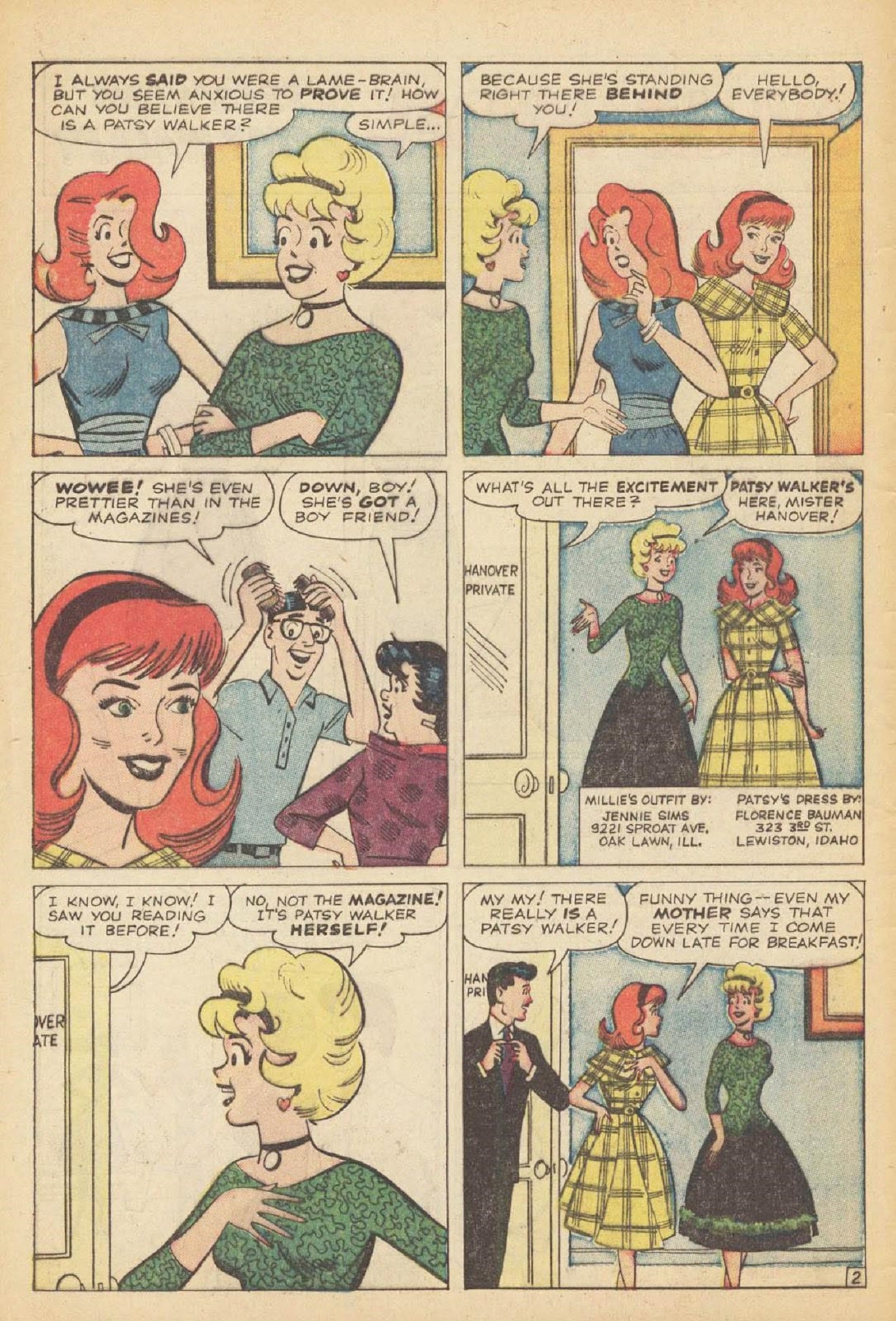
Millie Collins and Patsy Walker shared a unique relationship. Before the superhero boom of the 60’s, Patsy and Millie were the two reigning queens at Atlas Comics. They crossed over with one another a handful of times, the first one occurring in Patsy Walker #76. When Marvel Comics began shifting their publishing strategy back to superheroes, Patsy and Millie were the last two surviving comedy characters from the '40s. To this day Patsy Walker is Millie’s anchor to the modern Marvel Universe, with the two often appearing together.
To change with the times, Millie the Model did a gradual genre shift from comedy to soap opera. The series went from publishing multiple stories per issue to a single story format, with less of a focus on gags, while leaning more into drama. Millie The Model #134 was the last issue of Stan Lee’s 18-year run on the title. After the Spider-Man newspaper strip, Millie Collins has the record for the longest unbroken streak Stan Lee has writing a character.
Stan Lee was succeeded on Millie the Model by Roy Thomas, a man who would go on to become one of the biggest writers in the superhero comics industry. In fact, Modeling With Millie #44 is the first Marvel Comic Roy Thomas ever wrote. Thomas leaned into popular trends like the British Invasion, introducing a band called the Gears, who were clearly modeled after the Beatles. Thomas’ run was followed by Denny O’Neil, another writer who would revolutionize the comics industry.
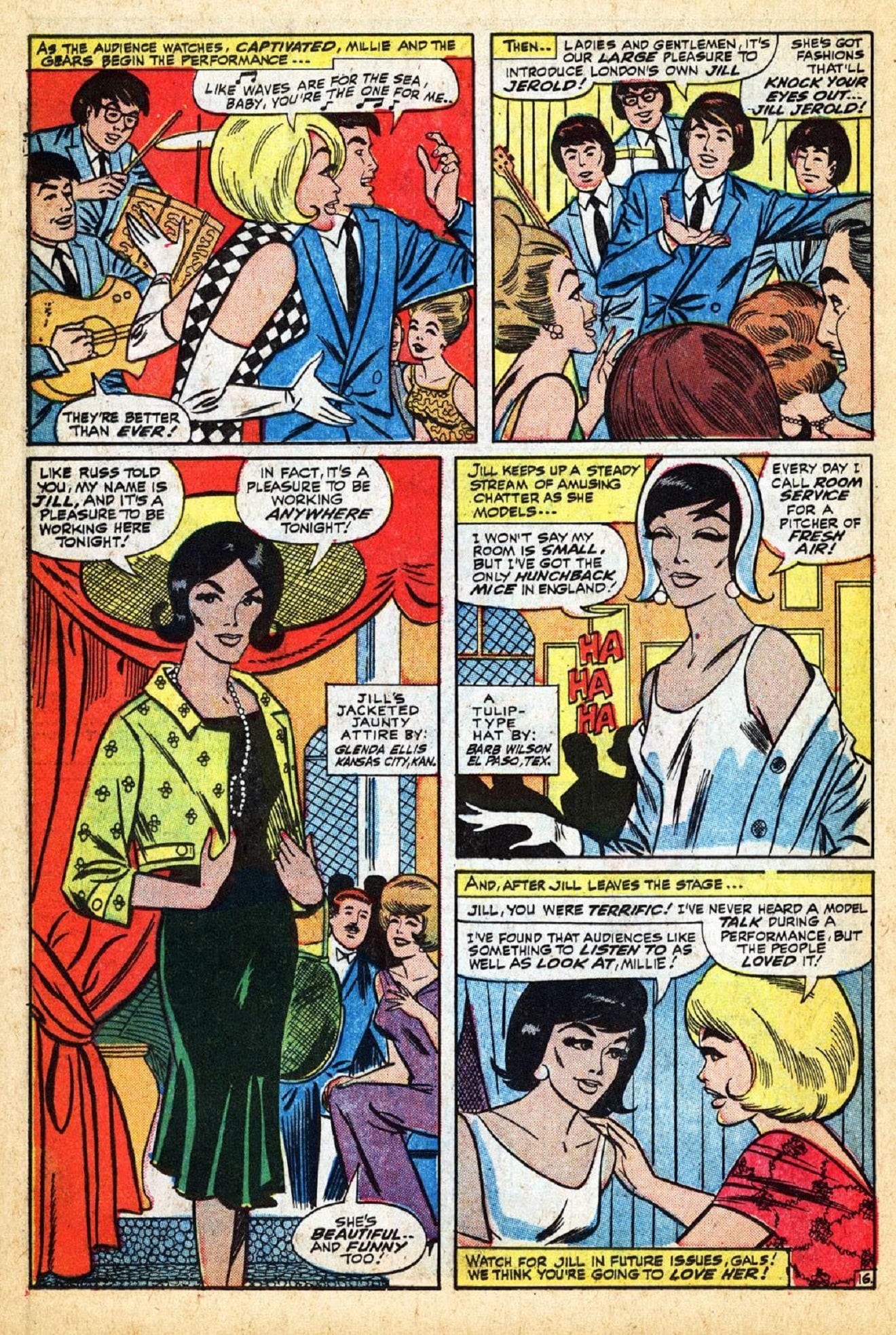
O’Neil tried to inject more action into the series, writing Millie skydiving and dodging foreign agents. He introduced Burt Chesney, an international secret agent who became engaged to Millie’s friend Toni Turner. In Millie the Model #141 O’Neil introduced Jill Jerold, the first black woman to have an ongoing role in a Marvel Comic. This was a groundbreaking move, and one that Denny O’Neil doesn’t often get credit for. During an interview with The Comic Archive, O’Neil credited Millie the Model for helping him learn how to write comics. “I’m grateful to her (Millie). I don’t know who was reading it, but I learned just the kindergarten level – the basic ABCs of comic book writing,” O’Neil mused.
By the end of 1966 the teen drama Patsy and Hedy was cancelled, and Millie the Model was the only non-superhero and non-western comic Marvel was publishing. As Marvel became known for their popular superheroes, Millie seemed to be the novelty in their lineup. The superhero titles often treated Millie like a punchline, with Captain America comparing his enemies to her in Tales of Suspense #59 (1964). When Marvel released a series of mini-books for gumball machines in 1966, Millie was the only non-superhero included, looking out of place alongside Spider-Man and the Hulk.
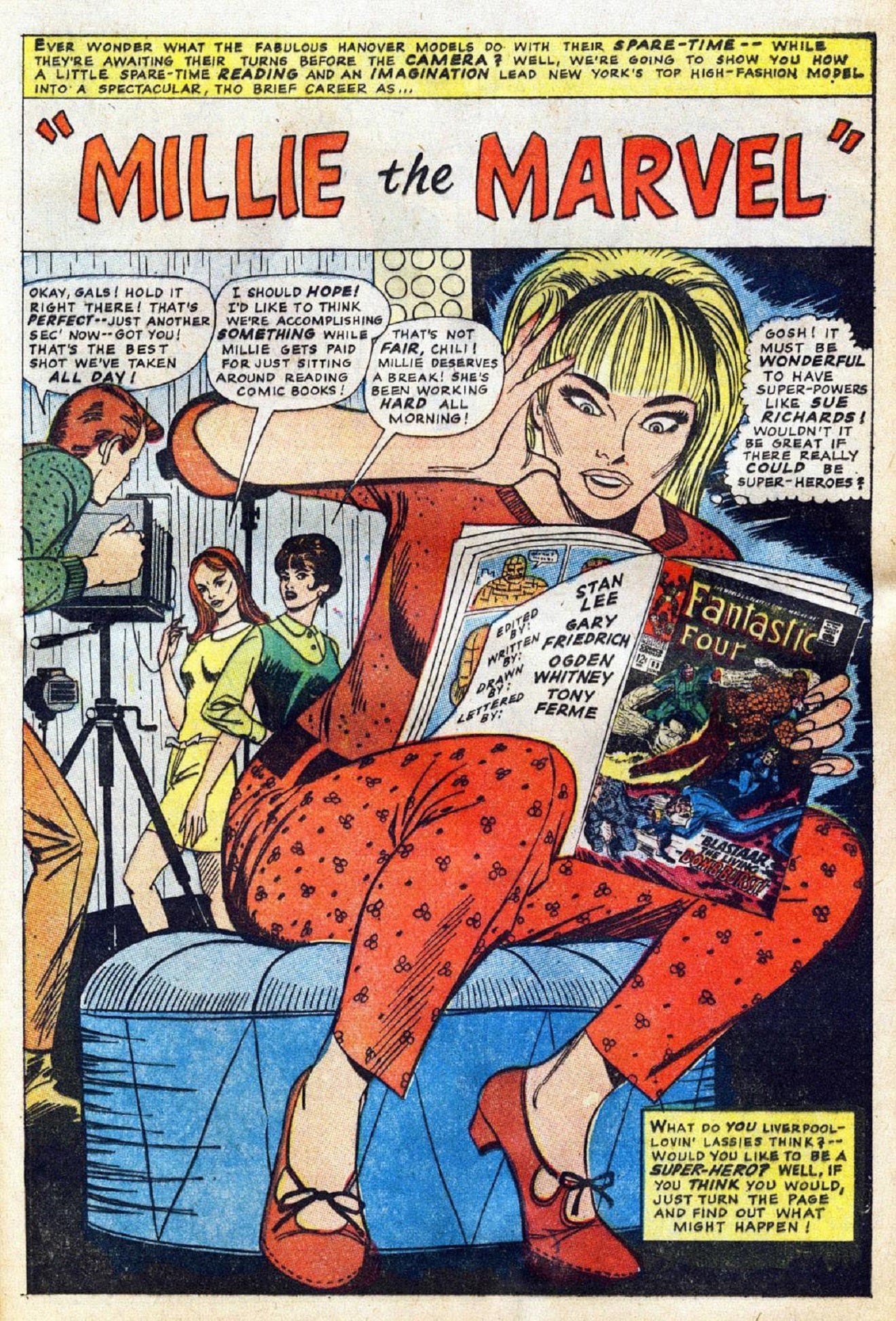
Fantastic Four Annual #3 featured cameo appearances from almost every character in the Marvel Universe, and although Millie wasn’t seen, she was referenced as a guest - by Patsy Walker and Hedy Wolfe of all people. This established Millie as a part of the Marvel’s superhero universe, although Modeling With Millie #54 (1967) later had her reading Fantastic Four, and wonder what the world would be like if they were real.
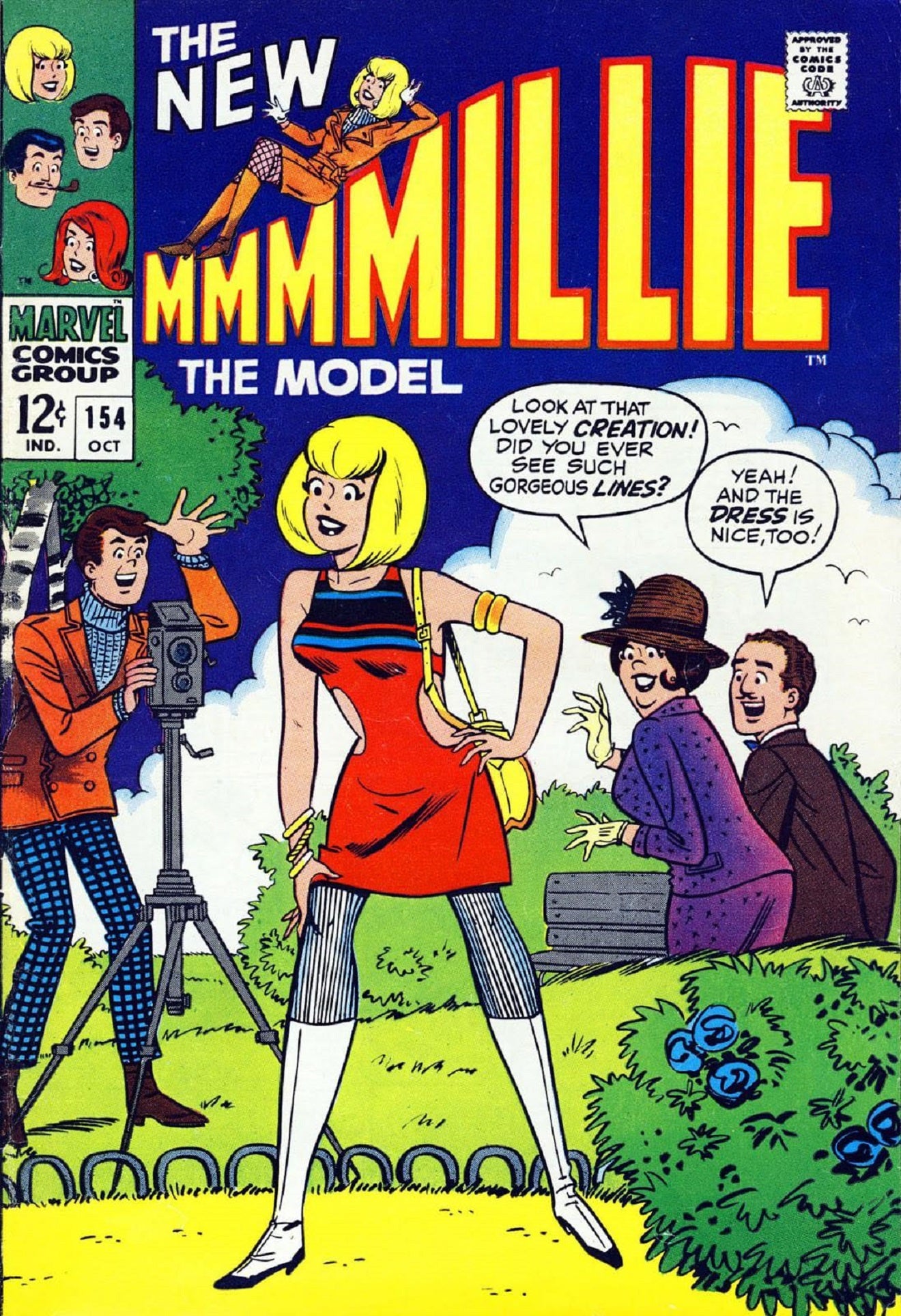
As the comic book industry continued to change, Millie the Model struggled to find an audience, so the series shifted back to humor. Millie the Model #154 (1967) returned the series to its slapstick roots, dropping supporting characters like Toni Turner and Jill Jerold. Sol Brodsy shifted his art style back to DeCarlo-inspired imagery from the book’s heyday. Stan Lee returned to write, remaining with the series for another four years.
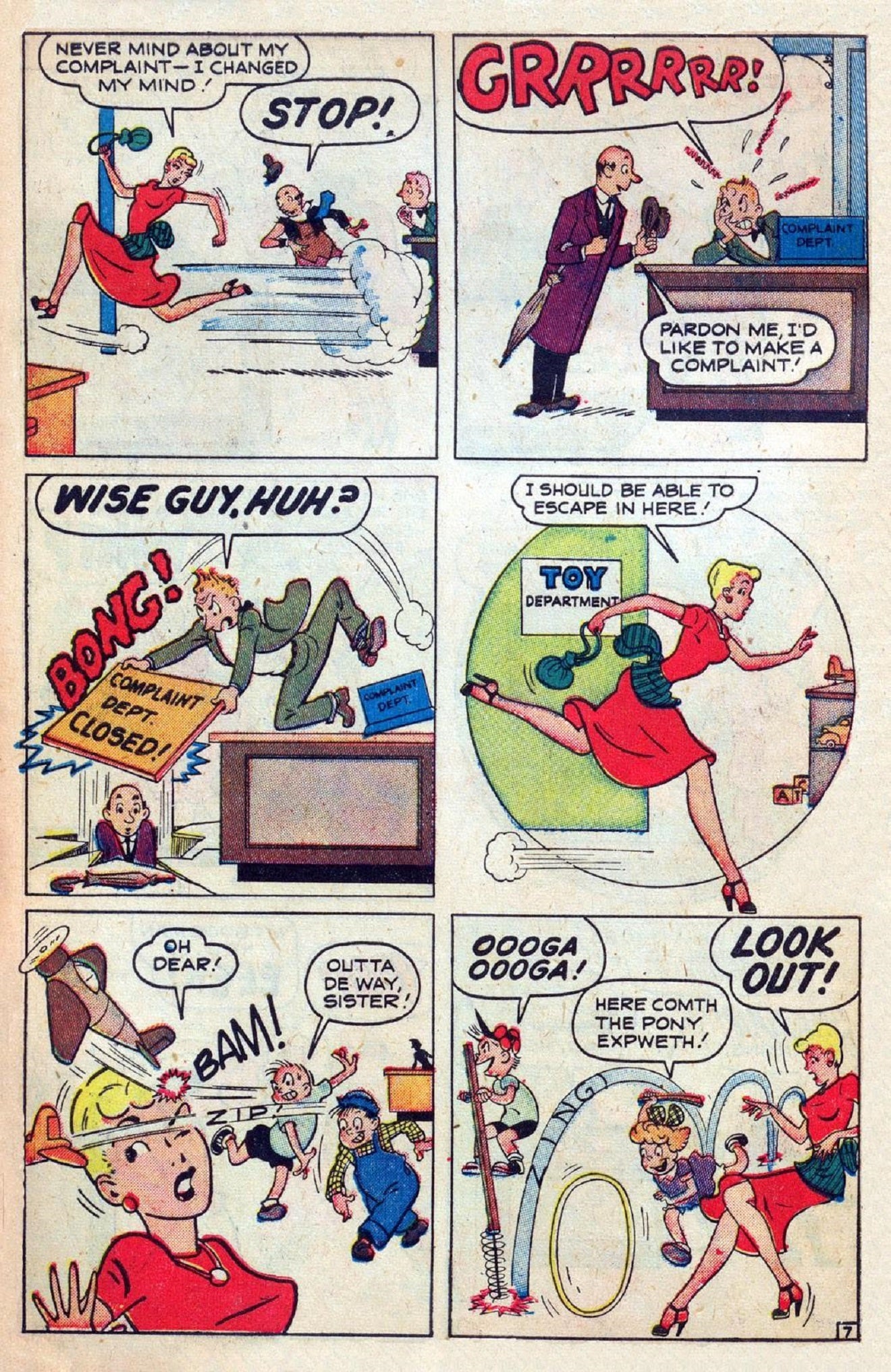
Stan Lee called the comedy genre his “first love,” and never got tired of writing for Millie. “I wasn’t running out of ideas. I found it easier than when I started because I knew the characters, their motivations, and the type of situations they would get into,” Lee wrote in his 2011 book Stan Lee’s How to Write Comics. Lee continued writing Millie the Model long after he had stopped scripting Marvel superhero titles like Thor, Iron Man, and Captain America.
Although the shift back to comedy had given the series a new life, the momentum had died down by 1973. Millie the Model began relying on reprints to supplement their new stories. Millie The Model #207 (1973) was the last regular issue of the title, with two giant-sized annuals following in 1974 and 1975. Millie’s uninterrupted 28-year publishing streak would not be matched by another Marvel character until the Fantastic Four reached that milestone in 1989. To this day, none of Marvel’s female led titles has surpassed Millie’s 207-issue run without renumbering. When it comes to legacy, Millie held many crowns, but by the Bronze Age the Marvel Universe had seemed to move on without her.
Millie the Model's revival on the runway
With her comic cancelled, Millie struggled to find a place in the contemporary Marvel Universe. Once a diverse publishing line with titles of various genres, Marvel Comics was now primarily publishing superhero adventures. In a world full of superheroes, where does a character like Millie fit in? Millie’s contemporary Patsy Walker adapted to this new world by becoming a heroine herself. In Avengers #144 (1975) Patsy adopted the identity of Hellcat, and fought alongside the Avengers.
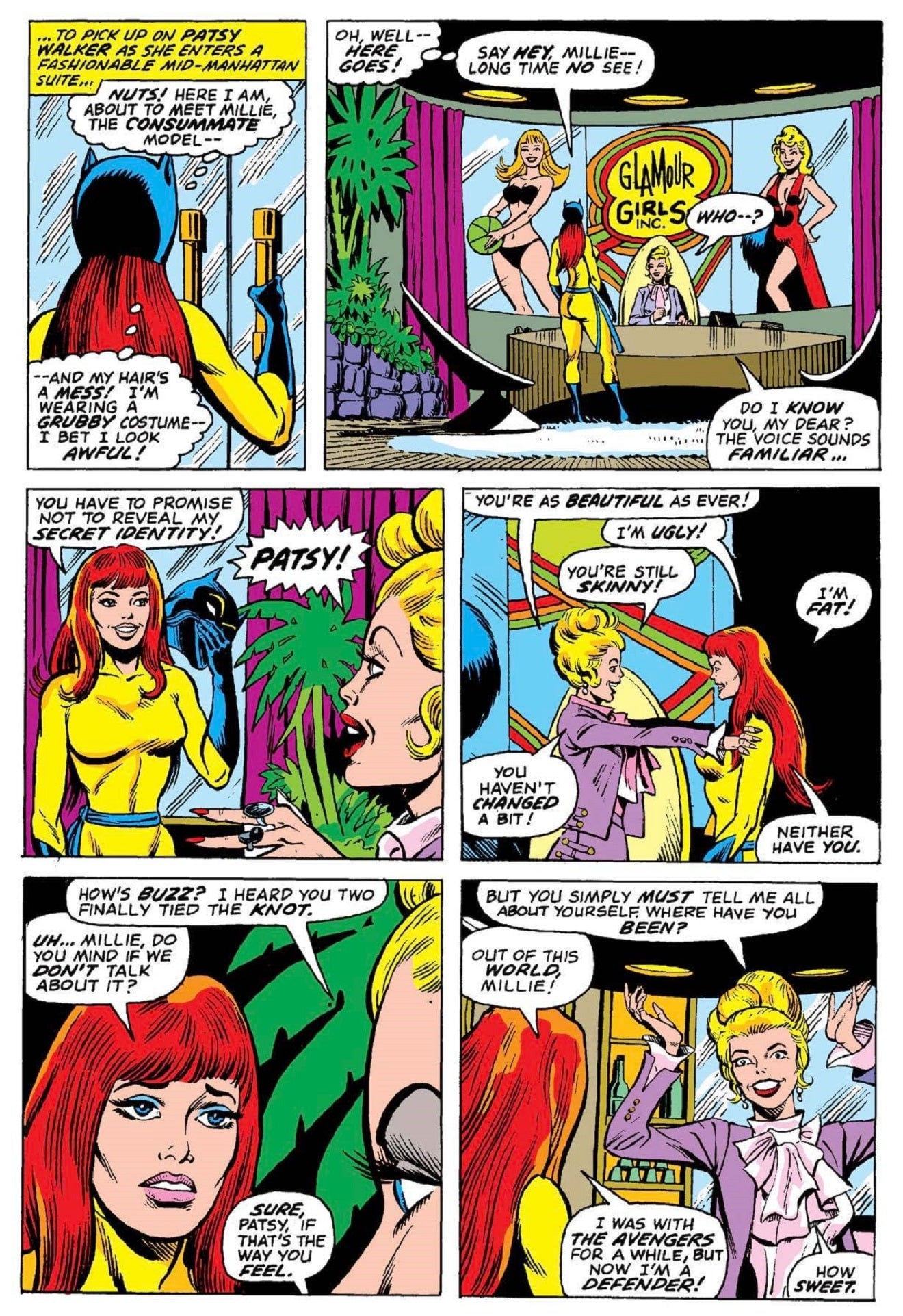
Defenders #65 (1978) featured a reunion between the two former comedy stars, giving Millie her first appearance since the cancellation of her title. Millie barely seemed phased when Patsy revealed that she was now a superheroine, simply remarking, “How sweet.” The old friends reminisced about their glory days, but as their conversation went on it became clear that Patsy no longer fit in with Millie’s world. After fighting alongside the Avengers and Defenders, Millie’s talk of fashion shows no longer excited her.
Whether intentional or not, the undertones of this conversation could almost be seen as a metaphor for Millie. Like her friend Patsy, the Marvel Universe had grown, and she was being left behind. After a brief cameo in Defenders #89 (1980), Millie would not be seen again until Dazzler #34 (1984). Millie was now the head of her own modeling agency, and recruited Alison Blaire (secretly the mutant known as Dazzler) to be one of her models. Millie’s new role shifts the power dynamic between her and Chili, who is hoping to get work at the new agency. A spiteful Millie takes great pleasure in turning Chili down, reminding her of all the cruel tricks she once played on her. The intervention of Alison Blaire convinces Millie to give her old rival another chance, putting an end to the decades long Millie-Chili feud – at least for now.
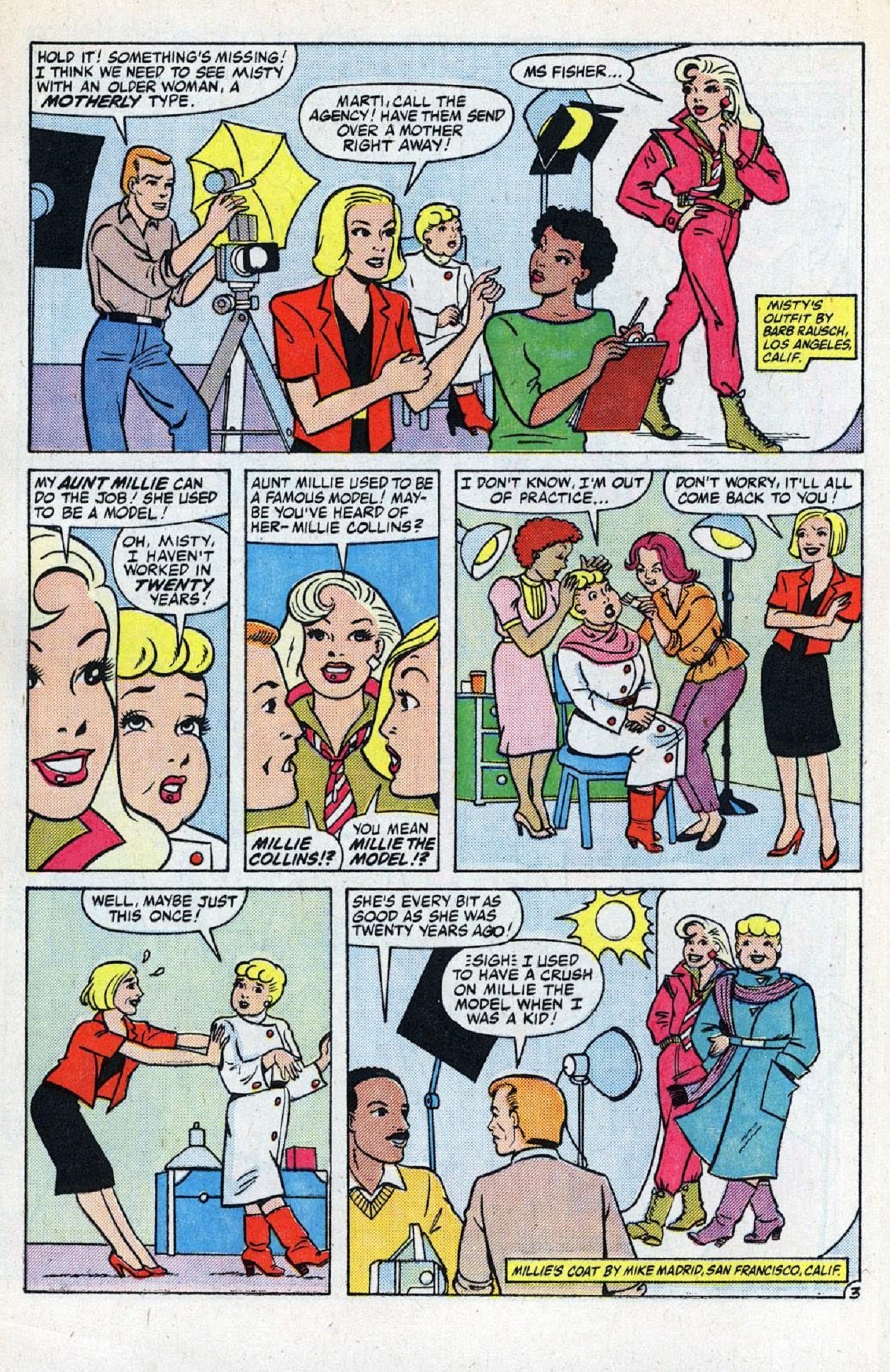
In 1985 Millie was given her first ongoing role since the cancellation of her title, but this time she would be a supporting player. Misty was a six-issue limited series published by Star Comics, a Marvel imprint geared towards younger readers. The title focused on the misadventures of Misty Collins, Millie’s teenage niece. Millie played a supporting role as Misty’s mentor. The former model was drawn to be slightly plump, and a few decades older. Readers didn’t respond well to Millie’s new physical appearance, and the letter pages were filled with requests to drop her weight.
Misty was written and illustrated by Trina Robbins, a famed creator and respected comic book scholar. The series revived many of the concepts from classic Millie the Model comics, like fan submitted designs, paperdoll cutouts, and advice columns. In her book From Girls to Grrrlz: A History of Women Comics from Teens to Zines, Trina Robbins wrote that Misty had a strong fan response, but Marvel still decided not to give her an ongoing once her mini-series ended.
Aside from cameos in Fred Hembeck illustrated comedy strips, it would be almost a decade before Millie was seen again in The Sensational She-Hulk #59-60 (1993). By now she was illustrated as a geriatric fashion mogul, looking to recruit She-Hulk to her agency. Her age should be taken with a grain of salt, as John Byrne’s The Sensational She-Hulk regularly broke the fourth wall, and played loosely with continuity. Millie’s subplot was cut short when the series ended, and the former superstar seemed destined to be relegated to cameos.
Millie was referenced as an Easter egg in comics like Marvel: Heroes & Legends #1 (1997), or given one-panel cameos in books like The Punisher Meets Archie #1 (1994). Despite her important place in Marvel history, the character struggled to find a place in the modern landscape. A revamped series called Millie the Supermodel was briefly pitched in 1997, but was ultimately abandoned. During a 2003 investor call, Marvel President Bill Jemas announced that Millie the Model would be reimagined as a teenage tennis prodigy for a new series called 15-Love. The concept was meant to draw in young female readers, and during the same call producer Avi Arad said that conversations were happening about a potential Millie the Model movie.
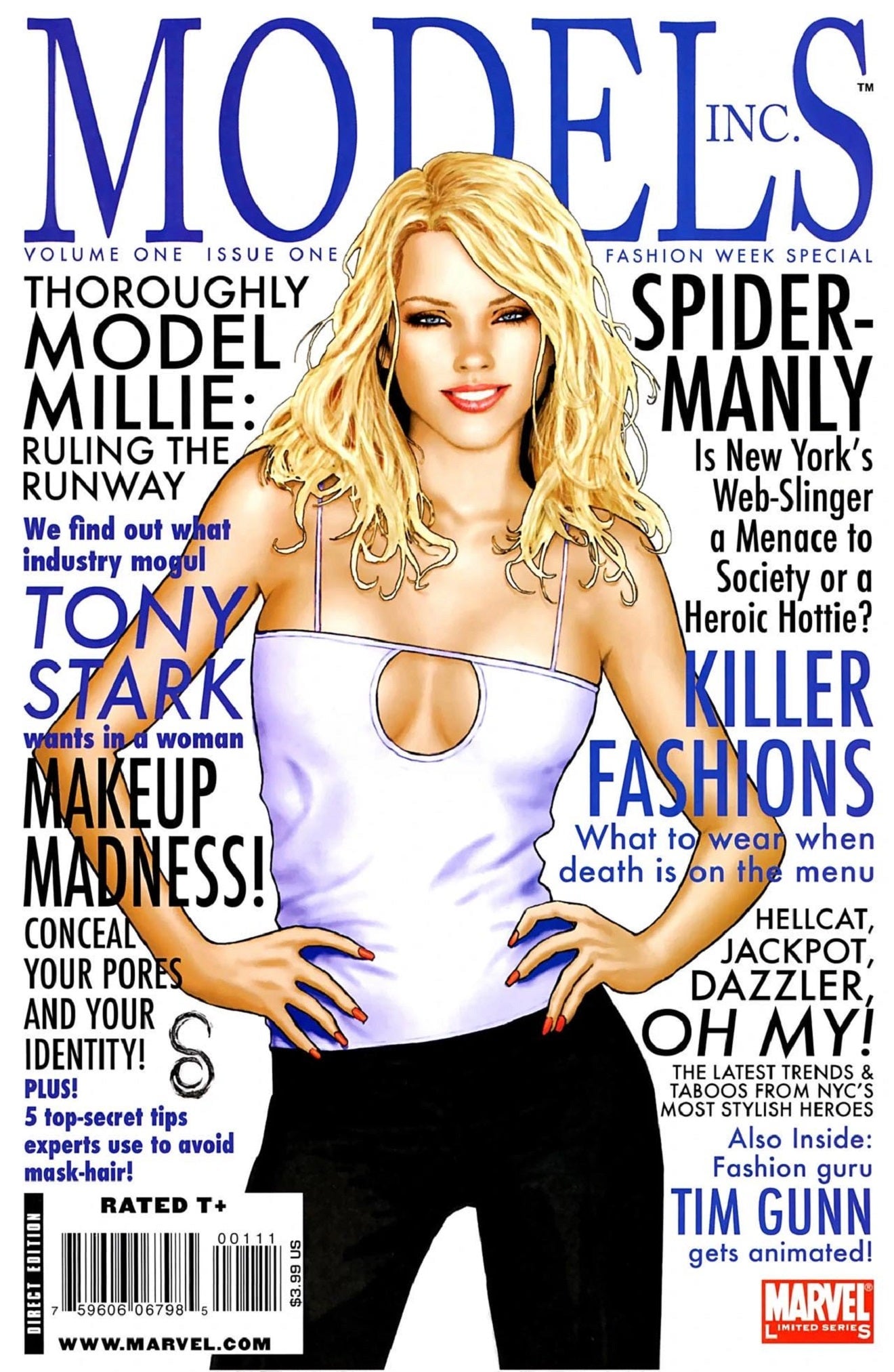
Despite the initial hype, Marvel held onto 15-Love for years, and the Andi Watson-penned mini-series wouldn’t see publication until 2011. The conversations surrounding a Millie movie never went anywhere either. In 2009 Marvel attempted another comeback for Millie with a mini-series called Models Inc. Unlike 15-Love and Misty, Models Inc. explicitly took place in the mainstream Marvel Universe, featuring guest appearances from characters like fellow model Mary Jane Watson and the Human Torch. The stakes were higher than Millie’s previous adventures, as this comic saw her framed for murder and her friends targeted by a mysterious villain.
Writer Paul Tobin brought back characters that hadn’t been seen since the Silver Age like Toni Turner, Jill Jerold, and even the Gears. The series leaned heavily into the fashion world, with a Perez Hilton inspired fashion blog in the back of each issue, complete with commentary from Hedy Wolfe (another revived character from Marvel’s early days). Real life fashion superstar Tim Gunn also made an appearance, suiting up as Iron Man during a backup story. The comic depicted Millie as a beautiful young woman, ignoring her aged appearances in Sensational She-Hulk and Misty. Women of Marvel: Celebrating Seven Decades Handbook suggested that cosmetic surgery might have been responsible for Millie’s renewed youth. Although Models Inc. didn’t lead to a full-scale Millie comeback, the former superstar was now being acknowledged as an important player in the history of Marvel.
Prior to the publication of Models Inc. Paul Tobin had included Millie in King-Size Spider-Man Summer Special #1 (2008). The story featured a team-up between some of Marvel’s most powerful women, including the Scarlet Witch, Jean Grey, Clea, She-Hulk, Hellcat, and Mary Jane Watson. Millie’s presence among these characters made it clear that she deserves to be acknowledged as one of the most important women in the Marvel Universe. This was reinforced further when Millie was given a story in Fearless #1, an anthology celebrating the legacy of Marvel’s leading ladies. She may not be the queen of comics, but this model is still getting gigs.
Millie the Model's cosmopolitan conclusion
Where does Millie go from here? Her leading lady contemporaries like Patsy Walker and Linda Carter have both found long term roles in the world of superheroes, while Millie still hasn’t found her place. Is there room for the character to evolve, and find a new place in modern comics? Or will Millie remain a legacy character, appearing in small roles that pay tribute to Marvel’s publishing history? Despite the historical nature of her series, Millie the Model remains one of the few Marvel titles published during the Silver Age to not be reprinted or collected. A few issues have shown up in anthology omnibus collections, but the title has never received a standalone collection, and many of the issues have never been reprinted.
It’s a safe bet that Marvel Studios probably won’t be producing a Millie the Model movie or Disney+ series, but that doesn’t mean she’ll be forgotten. She might not be as inspiring as Kamala Khan or Carol Danvers, but Millie’s status as a pioneer for marvelous women has given her immortality. If Millie never makes another comic appearance again, she can rest easy with the legacy she has. Thanks to Marvel’s current habit of renumbering, it’s doubtful that her record as Marvel’s longest-running female-led series will ever be surpassed. Her popularity allowed Marvel to survive before the superhero boom, something she may never get enough credit for.
But Millie’s story isn’t necessarily over either. After all, isn’t Marvel Comics a place where comebacks happen? Look at how the 2008 Iron Man film reignited and redeemed Robert Downey Jr’s acting career, or how an obscure monster from the Atlas Comics days like Groot is now a household name. Like the designer outfits of yesteryear on the discount rack, Millie the Model is a vintage piece waiting to come back in fashion.
The best place to find these hard-to-find Millie the Model back issues is comic shops. Here's our guide on finding the best comic shop for you.
Follow Popverse for upcoming event coverage and news
Find out how we conduct our review by reading our review policy
Let Popverse be your tour guide through the wilderness of pop culture
Sign in and let us help you find your new favorite thing.












Comments
Want to join the discussion? Please activate your account first.
Visit Reedpop ID if you need to resend the confirmation email.